
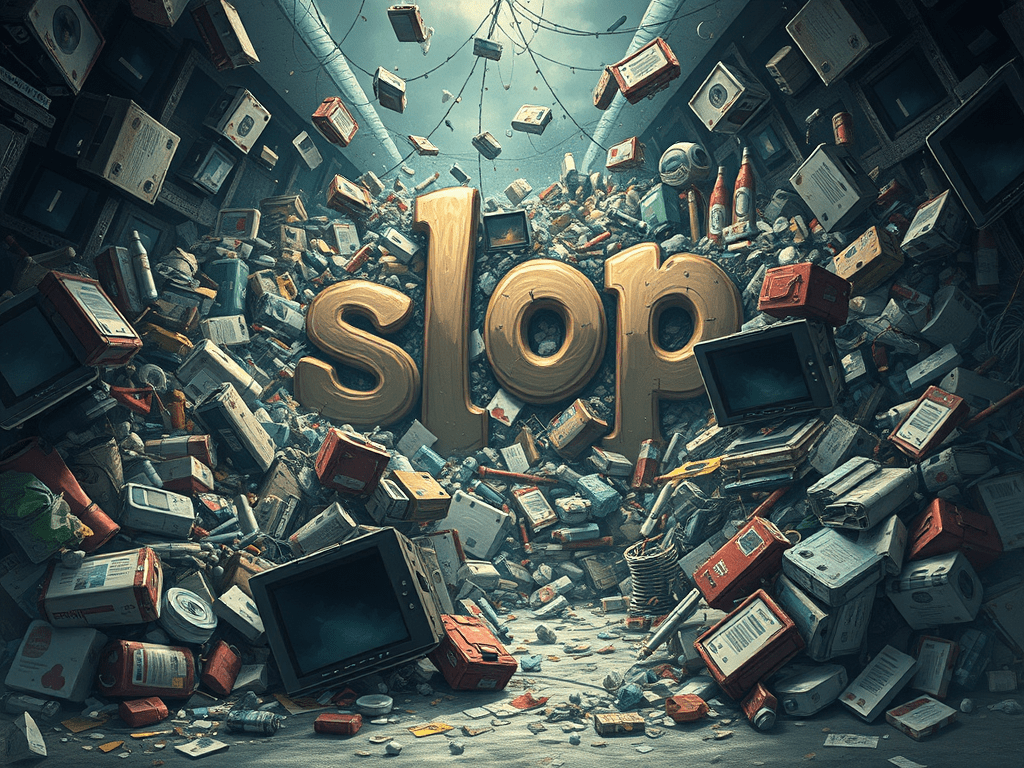
If you needed proof that the internet is eating itself, here it is: Merriam-Webster just crowned “slop” as Word of the Year.
Yes, slop. Not innovation. Not creativity. Not “the future.” Slop.
The dictionary is using it to describe the flood of low-effort, mass-produced digital junk filling our screens—much of it pumped out by AI. You know the stuff. Weird videos that make no sense. Animals “talking” with stolen voices. Books written faster than anyone could possibly care to read them. Content made not to say anything, but simply to exist… loudly.
What’s funny is that dictionaries all seem to be circling the same idea lately: technology is changing us, and not always in a good way. Collins picked “vibe coding.” Cambridge highlighted “parasocial.” Oxford went with “rage bait.” Different words, same message: we’re online too much, and it’s getting strange.
The word “slop” itself has had a rough journey. It started as mud. Then became leftovers. Then turned into a general term for rubbish. Honestly, that feels like a very accurate timeline for some internet content.
And here’s the best part: even Merriam-Webster admits people can’t agree on it. Some users hate slop. Others scroll endlessly through it at 2 a.m. while saying, “Just one more.” The word carries a bit of sarcasm too—as if to say, “Nice try, AI. This is what you came up with?”
The runners-up are just as telling. “Touch grass” went from insult to life goal. “Performative” became shorthand for people doing things purely for attention. Even political terms like “gerrymander” made the list, because manipulation is having a moment.
Last year it was “polarization.” Before that, “authentic.” Put it all together and the story is clear: we’re drowning in noise, craving what’s real, and slowly realizing that not everything generated deserves our time.
If “slop” is the word of the year, maybe the real question is this: why are we still eating it?
 DaiLY-bru
Leave a comment